Equipment

Filtration
Belt Press Filter
Continuous Solid-Liquid Separation & Sludge Dewatering System
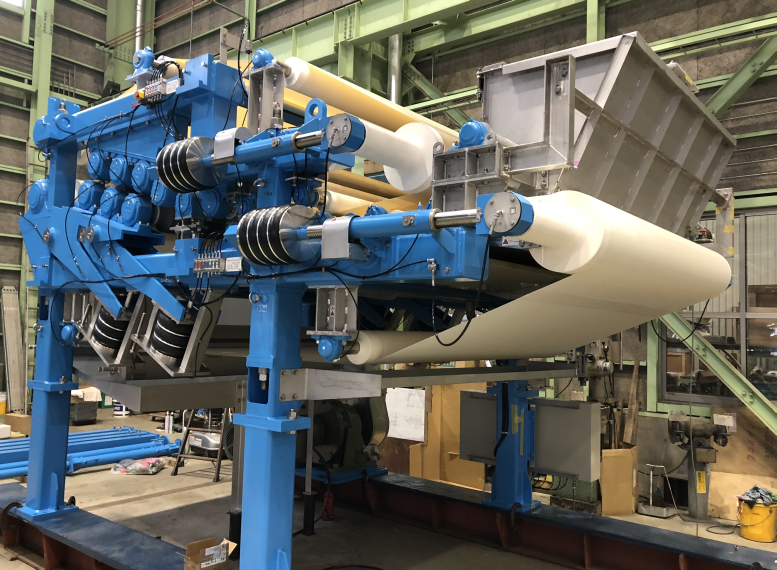
The Belt Press Filter, also known as a Continuous Belt Filter Press, is a continuous solid-liquid separation and dewatering system designed for high-moisture suspensions, sludge, chemical slurries, and industrial by-products.
By utilizing upper and lower filter belts combined with multi-stage pressing rollers, the system applies progressively increasing linear pressure to efficiently remove water and produce low-moisture filter cakes.
Belt Press Filters are widely used in industrial wastewater treatment, chemical processing, pharmaceuticals, food processing, and waste volume reduction applications.
Structure and Principle
The Belt Press Filter operates based on a continuous squeezing and dewatering principle.
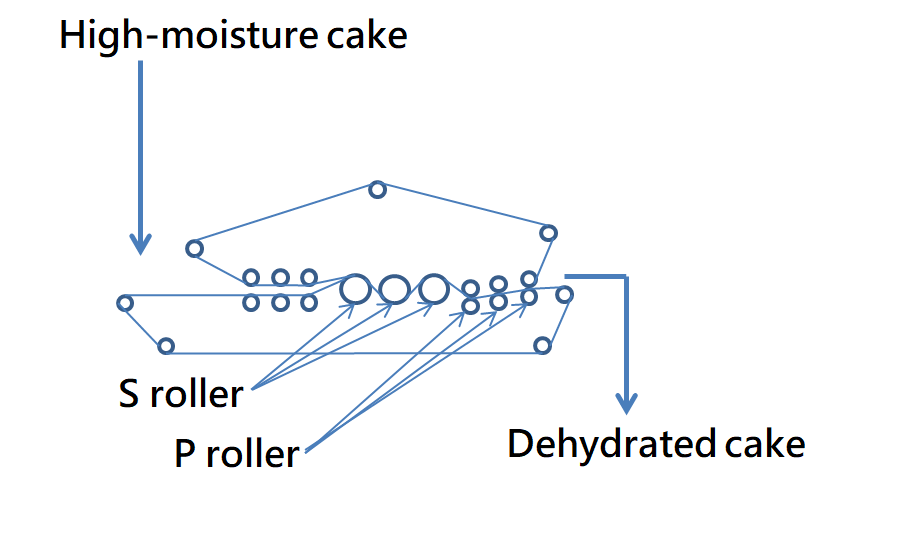
- Gravity Drainage Zone
The feed material is evenly distributed between two filter belts, allowing free water to drain naturally by gravity. This step reduces hydraulic load before mechanical pressing. - Low-Pressure Squeezing Zone (S-Rollers)
The partially dewatered material enters the initial pressing zone, where a series of rollers gradually increase pressure, forcing additional water through the filter cloth. - High-Pressure Pressing Zone (P-Rollers)
In the final stage, high linear pressure is applied to achieve maximum dewatering efficiency, producing a low-moisture filter cake suitable for downstream drying, incineration, or disposal.
This continuous process ensures stable operation, high throughput, and consistent dewatering performance without interruption.
The diagram illustrates the complete belt press filtration process, from material feeding and gravity drainage to staged pressing and filter cake discharge.
Description
Compared to batch-type filter presses or centrifugal separators, the Belt Press Filter offers:
- Continuous operation
- Large processing capacity
- Lower energy consumption
It is particularly suitable for high-volume industrial processes requiring long-term, stable dewatering performance.
By significantly reducing material volume and moisture content, the system lowers downstream drying, incineration, and transportation costs, and improves solid recovery efficiency. It is commonly used as a critical pre-treatment unit prior to final disposal or further processing.
Typical Applications
Belt Press Filters are widely applied in the following industries and processes:
- Industrial wastewater & sludge dewatering
Sludge volume reduction in wastewater treatment plants and chemical facilities - Chemical process slurry dewatering
Solid-liquid separation of chemical intermediates and by-products - Pharmaceutical processing
Dewatering of pharmaceutical suspensions and process residues - Food processing
Dewatering of food slurries, fermentation residues, and starch suspensions - Waste treatment & volume reduction
Moist solid waste dewatering prior to disposal or incineration
Principle & Operation Overview
The core operating concept of the Belt Press Filter is the coordinated action of filter belts and continuous pressing rollers, enabling progressive water removal from high-moisture materials.
The system integrates gravity drainage, low-pressure squeezing, and high-pressure pressing into a single continuous process. This design ensures efficient moisture reduction while maintaining stable filtration performance, even under high throughput conditions.
The operation diagram illustrates the complete process flow—from material feeding, gravity separation, staged pressing, to final filter cake discharge—providing a clear understanding of the dewatering mechanism and filtration efficiency.
Features
- Continuous operation suitable for 24/7 industrial processes
- High dewatering efficiency through multi-stage linear pressure
- Large processing capacity for high-flow applications
- Low filter cake moisture content, reducing downstream treatment costs
- Robust structure with easy maintenance
- Flexible filter cloth selection based on material characteristics
Specification
- Operation Mode: Continuous belt pressing and dewatering
- Applicable Materials: High-moisture suspensions, sludge, industrial slurries
- Pressing Mechanism: Upper & lower filter belts with multi-stage rollers
- Dewatering Result: Low-moisture filter cake discharge
- Industries Served: Chemical, pharmaceutical, food processing, wastewater treatment, environmental engineering
Actual capacity, dimensions, and configurations are available upon project-specific selection or technical inquiry.