Equipment

Others
Pipe static mixer
A pipe static mixer is an in-line mixing device that uses fluid kinetic energy to disperse chemicals instantly without moving parts or external power.
It is commonly used to replace flash mixing tanks when coagulants, neutralization agents, or oxidants must be uniformly dispersed within seconds.
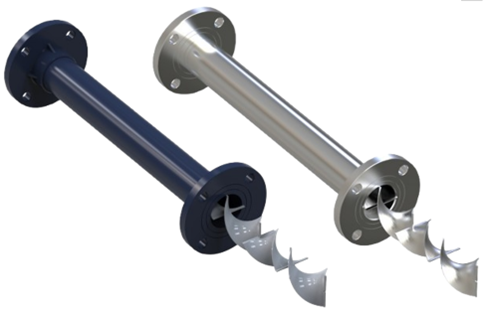
Structure and Principle
Fluid passing through alternating elements is repeatedly divided and recombined:
Mixing layers: N = 2ⁿ
This creates radial and shear mixing effective in laminar to turbulent flow.
Description
Mixing occurs during transport, preventing localized overdosing and reducing downstream reaction load.
Features
●No moving parts
●No power consumption
●Maintenance free
●Flash mixer replacement
●Instant mixing
●Continuous operation compatible
System Flow
1.Fluid enters pipe
2.Chemical injection
3.Pass mixing elements
4.Uniform mixing
5.Downstream treatment
Specification
Material: SUS304 / SUS316L / UPVC / PP / PE
Connection: Flanged / Threaded / Plain / Union
Elements:
Laminar 18–30
Transitional 8–18
Turbulent 4–8
Capacity
Suitable for low to medium/high viscosity fluids, gas-liquid mixing and suspended solids.
Application
Water: coagulation, neutralization, chlorination, polymer mixing
Chemical: acid-base, oxidation, blending
Food/pharma: homogenization, syrup mixing
Related field & Technology
Dosing system
Metering pump
Reaction tank
Aeration system
Technical Information
Geometric progressive mixing
Radial mixing
Laminar to turbulent flow
Straight pipe ≥5D
Injection ≥2D
Design Selection Guideline
In water treatment and chemical dosing systems, the choice of mixing equipment depends on required contact time, mixing uniformity, and installation constraints. When chemicals must be dispersed instantly rather than relying on retention time, a pipe static mixer is generally preferred over a flash mixing tank.
Recommended conditions for static mixer:
- Rapid contact within seconds (coagulation, neutralization, oxidation)
- Continuous flow process
- Limited installation space
- Energy saving and low maintenance required
- Stable dosing ratio required
Recommended conditions for mechanical mixing tank:
- Long retention reaction required
- High solids or gel-like fluid
- Adjustable shear intensity required
- Mixing and reaction must be independently controlled
This guideline can be used as a selection reference for rapid mixing equipment in water treatment.
Mixing Mechanism Comparison (vs Flash Mixer)
Conventional flash mixing tanks rely on bulk circulation generated by mechanical agitation, allowing chemicals to gradually disperse throughout the tank volume. Mixing uniformity is influenced by impeller speed, liquid level, and internal flow patterns, and localized high concentration zones may temporarily occur.
In contrast, a pipe static mixer repeatedly divides and rearranges the fluid inside the pipeline, creating layered cross-flow structures. This contact-type mixing mechanism immediately entrains injected chemicals into the main flow, reducing localized overdosing and improving coagulation and neutralization stability.
Therefore, for reactions dominated by contact efficiency rather than retention time, static mixers typically achieve uniform mixing faster than flash mixing tanks, while retention-controlled reactions remain better suited to mechanical mixing.
Others
Can it replace a flash mixer?
Yes, in most rapid chemical contact reactions.
Can it operate at low flow?
Yes, by increasing element quantity.
Does it cause pressure drop?
Yes, but typically lower energy cost than agitation.
Does it need power?
No, mixing energy comes from flow velocity.
When not recommended?
For long retention reactions or very high solids concentration.